
Are You A Classics Collector?
3 tips from a librarian for choosing the best book to buy
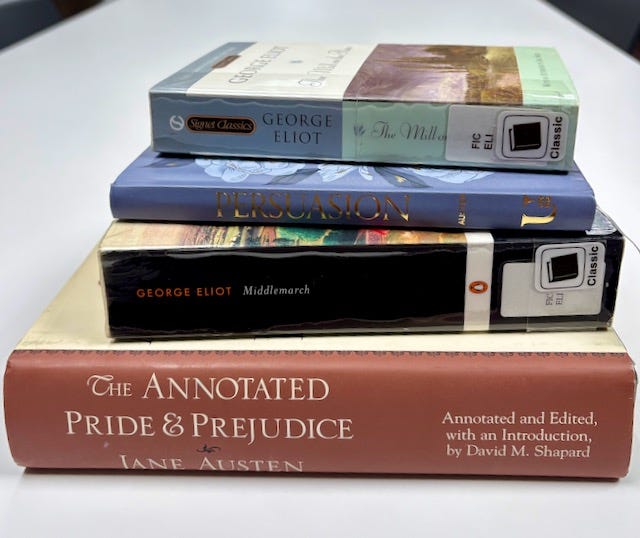
It’s senior brit lit paper all the time this week at my high school. This is a Very Big Project and the deadline is looming. When I have my lunch break and peruse Substack, I see so many people writing about their ambition to read more classics in 2026 or joining a group read of a classic. The universe is sending me a message to share what I’ve learned about choosing the best copy of a classic book to purchase.
(Apologies in advance for all the photos of books with a white background. All the tables in my library are white).
#1 Learn the lingo
There are a lot of book terms tossed around that you probably feel like you should know but maybe aren’t actually sure about.
Mass market paperback - These are the smaller sized paperback made with cheaper materials. They’re affordable and portable.
Trade paperback - This is a larger size paperback. It will have more room in the margins, is made with better quality materials, and isn’t as cramped in your hand.
Edition - An edition is a specific version of a book. Some publishers put out an entire series of classics which might be periodically updated. These updates are numbered to indicate changes have been made. That’s what labels like “3rd edition” mean. Editions can also indicate the type of content included, such as the examples below. Finally, when significant revisions are made to a text the publication year will be used to differentiate between them. The 1818 versus 1831 editions of Frankenstein are a well-known example.
Annotated edition - Annotations are notes included by the publisher. Many books come with annotations such as footnotes that translate Latin phrases or explain archaic language. A book advertised as an annotated edition, such as the one above, will have extensive annotations, including commentary by the editor or illustrations.
Critical edition - A critical edition will include essays of literary criticism about the text and are often used in university classes. (Free citation sources! as I advertise to my students). If you would like a deeper exploration of the text, a critical edition is a good choice.
Facsimile edition - A reproduction of the original published manuscript. These can be fun, especially if they have illustrations. Keep in mind they will have the original typesetting, include errors that were later corrected, and the antiquated spelling will not be updated.
Abridged edition - An abridged book has a shorter, and sometimes simplified, version of the original novel. These are commonly used in schools. You are more likely to find books labeled unabridged, meaning it is the complete novel.
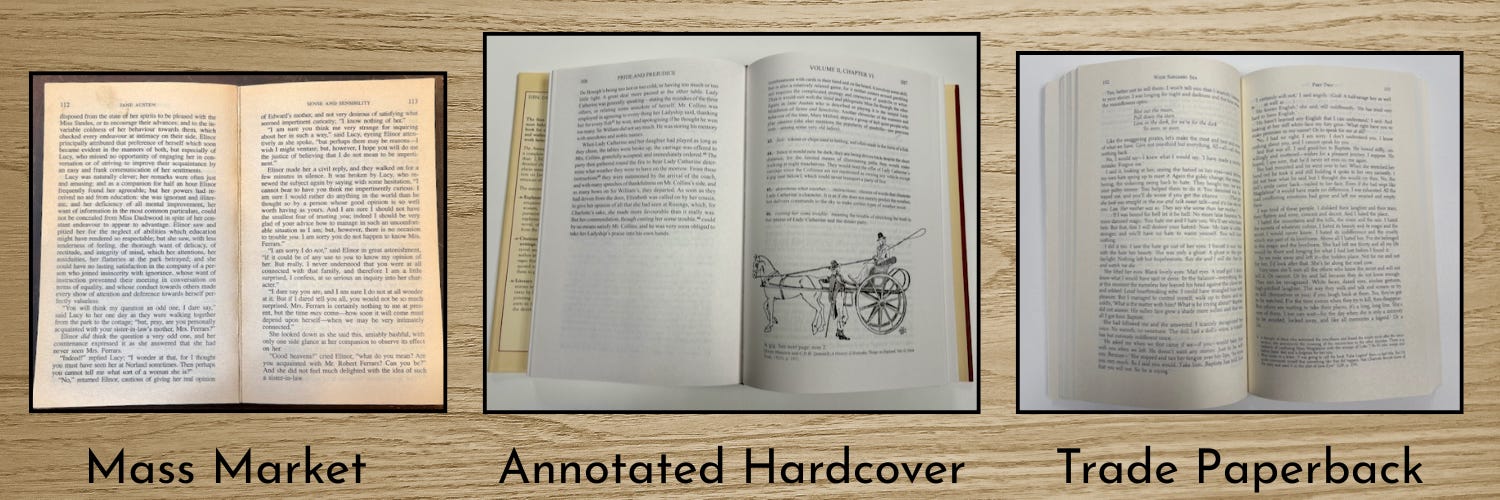
The old mass market paperback on the left has yellowed pages because the paper is lower quality. Notice the small print and margins. The only reason I was able to get a picture of it open flat is because the spine was broken in this spot.
The hardcover in the center is the David M. Shapard annotated edition of Pride and Prejudice. The text is on the left page and the annotations on the right. I loved reading this version.
The trade paperback on the right is able to sit open on its own. It has roomier margins and footnotes as needed, but there aren’t notes on every single page.
#2 Know what kind of reader you are
As you can tell from the glossary, books are made to fit the personalities and needs of readers. Mass market paperbacks are great if you are on the go and want to have your book on hand for when you have a few minutes between activities. But if you’re a homebody read and love the way a collector’s edition looks on your bookcase, you might want to pay a little more to get an edition you’ll be happy with.
If you’re just dipping your toe into classics and are intimidated by the advanced/antiquated vocabulary found in these books, I highly suggest getting an annotated edition. After you’ve learned the different types of carriages and understand how a court dress is different from a morning dress you’ll be ready to buy your next classic in a version without so much explanation.
Annotated editions are also great if you are buying a favorite classic. The edition of Mrs. Dalloway annotated by Merve Emry includes excerpts from Virginia Woolf’s diaries and notes on writing. It also has more than 100 photos and illustrations. If you’re a Pride and Prejudice fan, there are editions where you can open envelopes containing reproductions of handwritten letters sent by the characters of the story.
Do you like to mark up your books with marginalia? Definitely skip the mass market paperback—it’s too cramped. However, you might be as happy with a trade paperback as a hardback. This might shock a few people but hardbacks are not always better quality than paperbacks. Book quality has been reduced over time to save money and many hardbacks are manufactured on the assumption that they will only be read once. I’ve glued many a cover back onto the spine after only 2 or 3 checkouts. A Penguin paperback, on the other hand, is made to survive living in a student backpack for months at a time.
#3 A warning if you like to shop online
[Love you indie authors! None of this section is referring to you.]
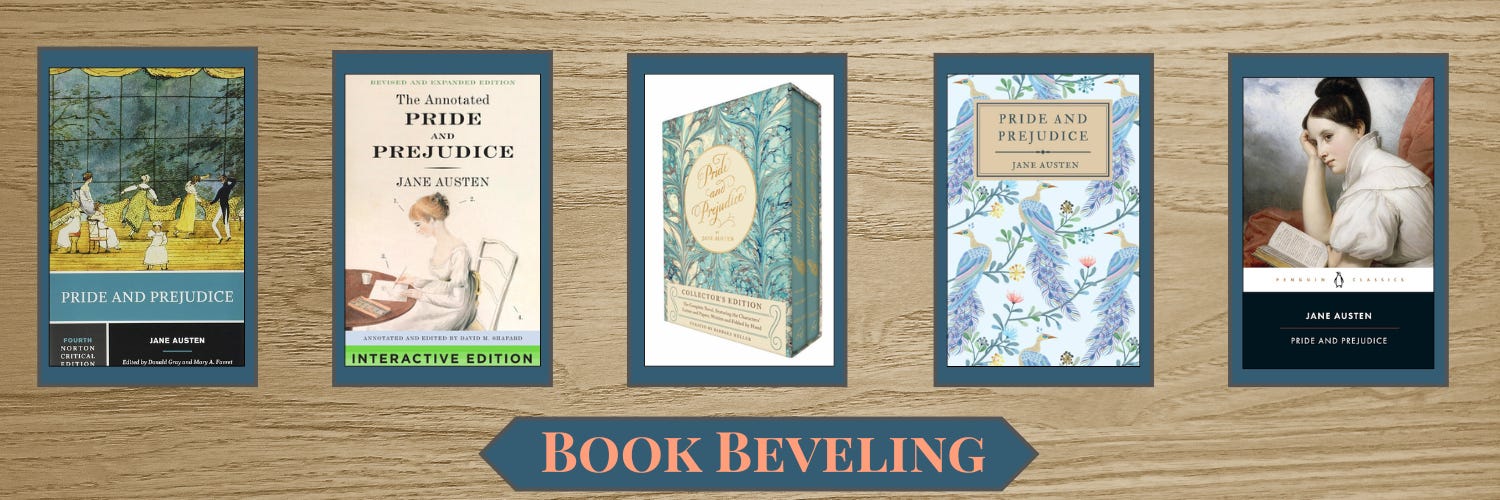
Substack has a very pro-indie bookstore vibe but I’m sure some of you can’t resist the temptation of Amazon’s prices and practically instant delivery. It is awash in print-on-demand copies of public domain works. This means people take the text from Project Gutenberg and paste it into the “self-publish your book” platform. Think they’re easy to spot? Take another look at my graphic with five copies of Pride and Prejudice. The second from the right with a Dover-esque cover is a self-published book labeled “Peacock Edition” to take advantage of the famous 1895 version.
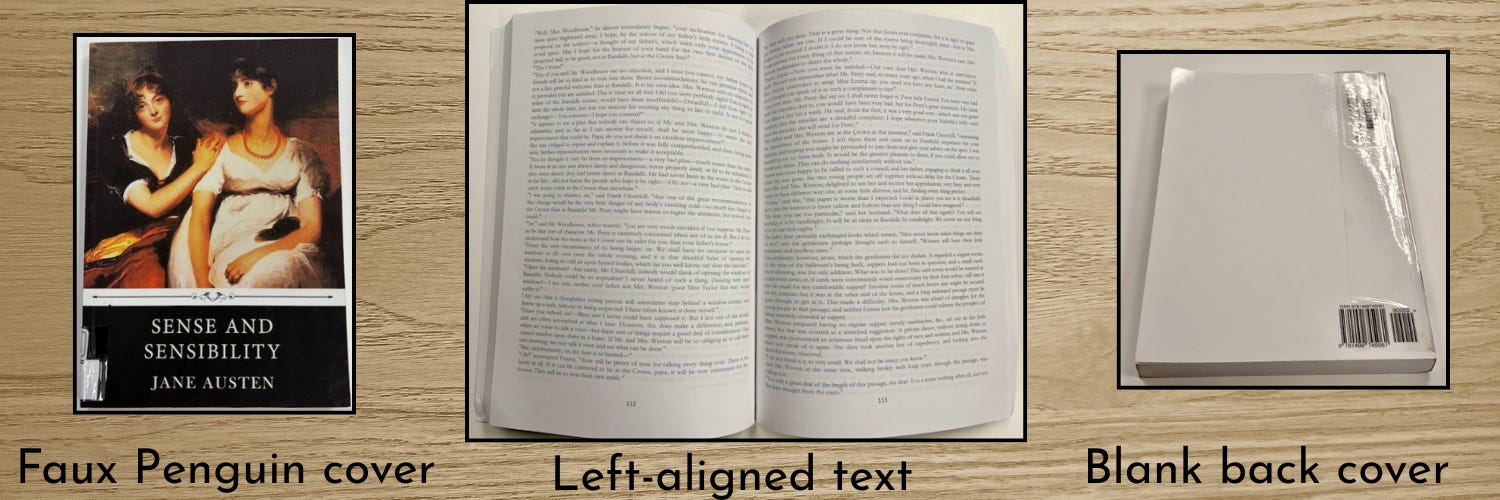
These books are listed at rock bottom prices. People buy them because they’re cheap and that pushes them up in the listings. I’ve seen so many students bring these in because they aren’t labeled as self-published. Let me tell you, the art of typesetting is unappreciated until you try to read a book without it. Check out an example below.
Here’s what to look for:
Always check the publisher information. Amazon self-publishing offers the option to create your own press name. Take the time to Google the publisher’s name if you haven’t heard of it.
Look for pictures of both the front and back cover. Almost all the “self-published” versions of classics I’ve seen have nothing on the back except for a bar code.
A picture of the spine is not standard, but putting the title on the spine is an extra step in the self-publishing process. Most people seem to skip it.
Check the reviews for complaints about the formatting.
This is mostly an Amazon problem. I haven’t seen them at other big online bookstores like Barnes and Noble (who publish their own good quality line of classics in both affordable and collectible hardcover versions). When I searched Walmart, they did have a few show up as a 3rd party vendor option.
Bonus: Translations
If you are reading a book in translation, know that there can be substantial differences in how a book reads depending on who translates it. For example, the first English translation of Sigrid Undset’s Kristin Lavransdatter trilogy was completed by Archer and Scott, who chose a stilted Medieval tone, in the 1920’s. When Tiina Nunnally completed a new translation in a clear, simple style around 2000, the work became accessible to a wider audience.
The best advice I can give you for choosing a translation is to check online to find different translation options. Go to a bookstore and browse the versions you find. You might be surprised at how strongly you dislike one and connect with another. Whether it’s a very literal translation or a modern style with English idioms included, the best choice is going to be the one you will enjoy the experience of reading.
What a generous post, Kelly, thank you so much for sharing it! As someone who is often intimidated by the 'forest' of different editions at the bookstore, this feels like a map. I especially loved the advice on annotated editions—sometimes a little extra context is exactly what’s needed to make an 'intimidating' classic feel like a friend. Wishing you luck with senior papers!
Never even knew there were things to know about buying a classic.