
Purple Hibiscus read along
A deep dive into Chimamanda Ngozi Adichie's debut novel
Welcome to Book Beveling’s first read-along! It begins today and runs through April 1st. I read Purple Hibiscus for the first time last year when I was trying to add a few diverse options for the British Literature paper at my high school. I was blown away and wished I had someone to discuss it with. I wanted to read it again this year and thought it was the perfect opportunity to have Substack community friends join the discussion. The timing couldn’t be better—it will overlap both Black History Month and Women’s History Month. Those of you who are Christians observing the Lenten season will find it a fitting choice as well. Or read it simply because it’s an amazing book.
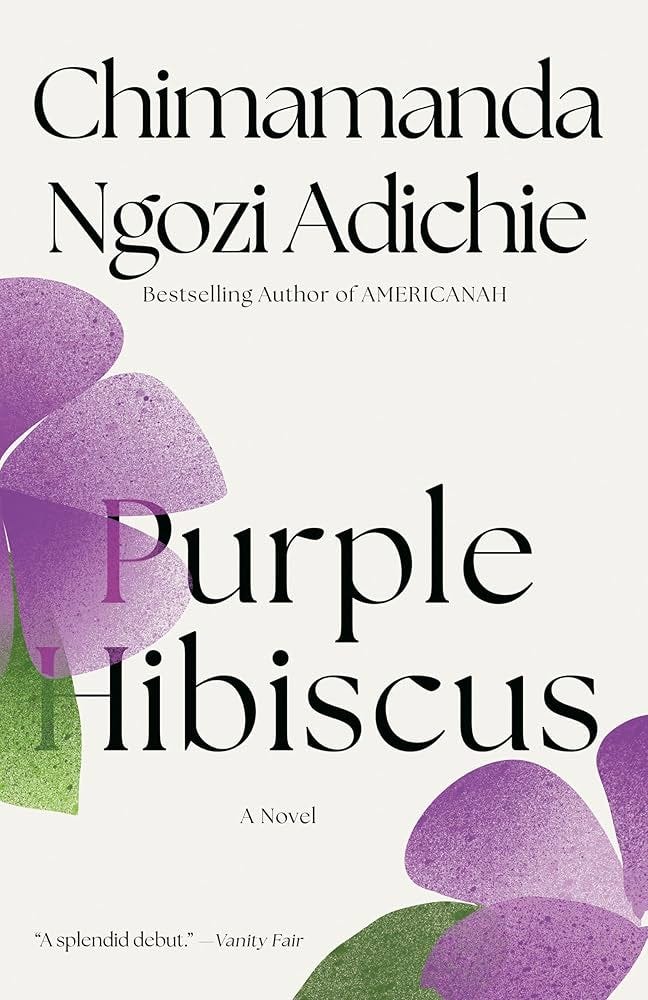
Purple Hibiscus (2003) was Chimamanda Ngozi Adichie’s first published novel. It won both the Hurston/Wright Legacy Award and the Commonwealth Writers’ Prize for Best First Book. It was long or short listed for several other literary awards. It might just be my internet circles, but I feel like people focus on Adichie’s later work, especially Americanah, and never mention Purple Hibiscus. One reason might be that the immersive Nigerian setting is less comfortable for American readers than her books set in the US.
Purple Hibiscus is a coming of age story centered around fifteen year-old Kambili Achike and her wealthy Catholic family who live in Enugu, Nigeria. Kambili’s abusive father is a prominent member of the community. He supports the local Catholic parish financially and runs an important political newspaper. When Kambili and her brother are sent to visit her aunt’s family, they experience a different type of family life and view of religion. Post-colonial Nigerian politics impact both their father’s and aunt’s livelihoods.
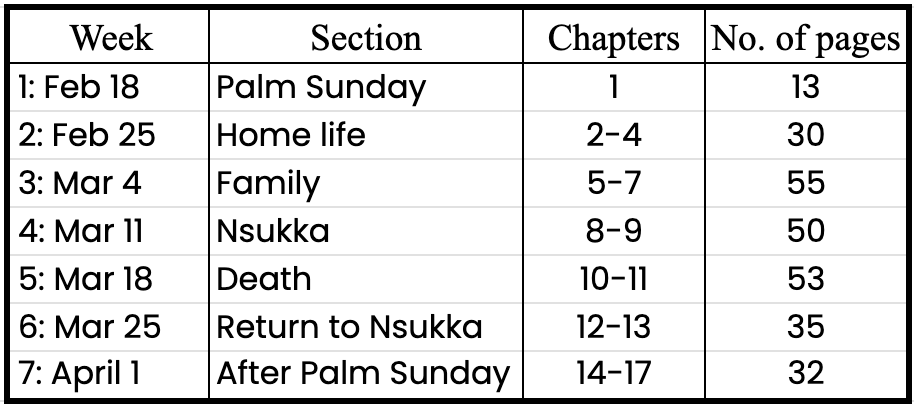
Reading and Discussion Schedule
The chapters in Purple Hibiscus aren’t numbered. I added numbers to my text to make it easier to keep track. The longest chapters are in the middle of the book with shorter chapters in the beginning and end. I broke the novel into sections based on the story progression.
Background on the Setting
Post-colonial Nigeria is our setting, during the time period when it was ruled during a series of military dictatorships. Kambili’s family, who live in Eastern Nigeria, are part of the Igbo ethnic group and at times speak in Igbo. They are Catholic, reflecting Nigeria’s large Catholic population. Adichie was raised Catholic but is not a practicing Catholic.
I like to look up pictures of food and clothing when I’m reading about an unfamiliar culture so I can visualize the setting. I live in a city with a thriving food scene, so I ate at a Nigerian restaurant to try the food. Some of the meals characters eat are national dishes and others are regional cuisine from eastern Nigeria. Women wear a “wrapper” which is a large rectangular piece of cloth tied to make a skirt (see top photo). Kambili’s cousin Amaka likes to listen to what she calls indigenous music rather than Western music. The musicians like Fela Kuti are real and you can stream their music through your favorite platform.

Stew with fufu, photo by Femoree on Unsplash
Chapter One Discussion
As a writer, I’ve read a lot about how a good book should begin. The first chapter of Purple Hibiscus is a masterclass, an encapsulation of the novel in fifteen pages. After you’ve read it, come back and read my thoughts.
I was stopped by the first sentence.
“Things started to fall apart at home when my brother, Jaja, did not go to communion and Papa flung his heavy missal across the room and broke the figurines on the etagere.”
Things Fall Apart is a novel by Nigerian writer Chinua Achebe published in 1958. Achebe is considered “the father of African literature” in the post-colonial era. He was the first published author to write about Africa from an indigenous point of view instead of the common European perspective looking down on the unenlightened natives in the dark continent. Adichie is often considered the successor to Achebe.
Besides the allusion to Achebe, the first line includes all four family members and their defining characteristics. Our narrator, whose life falls apart. Her brother, who does not cooperate. Her father, who destroys. The figurines are her mother’s prize possession–and so we bring in her mother, who is broken.
After establishing Palm Sunday as the day these events are taking place, the first paragraph turns to Papa. Adichie spends the next two pages describing Papa. Each sentence and adjective paints the picture of a man who deals in extremes. He always sits in the front pew. He shuts his eyes so hard that his face tightens into a grimace. We are introduced to two other characters, Father Benedict the parish priest and Ade Coker who is editor for Papa’s newspaper. Both hold Papa up as a model of righteousness and justice.
We learn that Papa is angry because Jaja did not take communion. As Papa polices who takes communion (something which is supposed to be private) in order to report to the priest, he presumably feels Jaja’s decision makes him look bad. After Papa breaks the figurines that are special to Mama, she enters the room to clean the shards wearing a “God is Love” shirt (irony alert!) with her wrapper skirt.
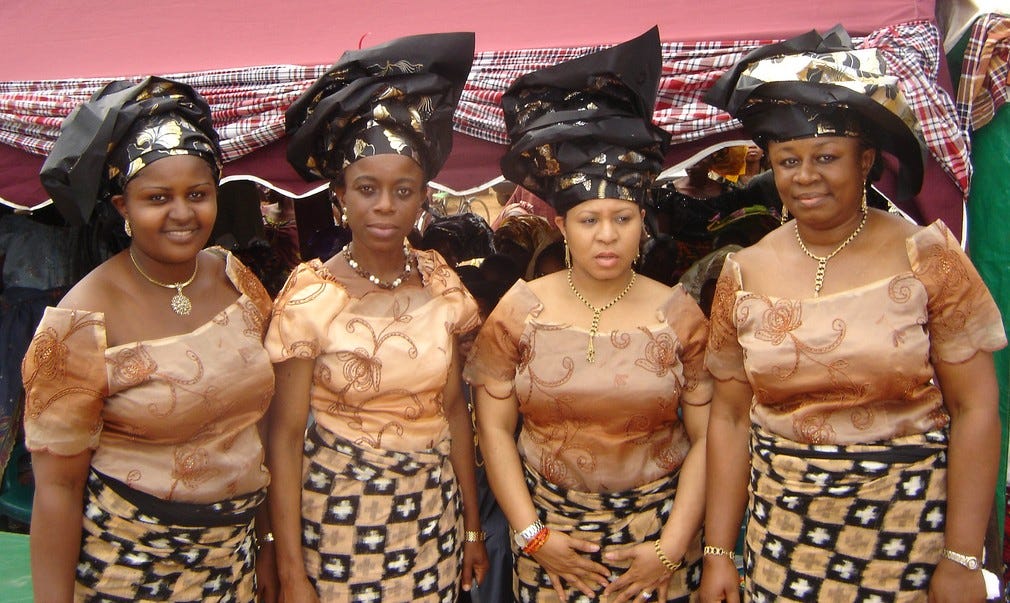
Nigerian women wearing the “wrapper” skirt mentioned in Purple Hibiscus. Linda Adiele, Creative Commons
After his little tantrum, Papa drinks tea. It is his custom to offer each of his children the first sip. “A love sip, he called it, because you shared the little things with the people you loved.” This sounds very sweet, but Kambili continues on to say that because the tea is scalding hot it always burns her tongue. So, she learns that her father’s love burns. We get a few more hints of Papa’s wealth and his political opinions. For example, one must speak English to sound civilized.
As the chapter concludes, Kambili reflects that “when Papa threw the missal at Jaja, it was not just the figurines that came tumbling down, it was everything.” What is everything? Everything was how their family lived before they visited Aunty Ifeoma’s apartment in the city of Nsukka. Next week’s chapters will show us their life before that visit.
What are your thoughts on the first chapter?
I love your choice of books. I'm such a Chimamanda Ngozi-Adichie fan! This is her only book that I haven't read. It will be interesting to read along.