
Reader, Writer, and Librarian
My bookish life
Congratulations, you’re a librarian!
I became a library by accident and a published author through luck.
After staying at home with my children for well over a decade, I decided I was ready to re-enter the workforce. I still had a multitude of obligations at home (if you have kids with medical issues, it requires a large amount of unpaid labor hours) so I wanted a part-time position, preferably flexible around my kids’ school schedule. Serendipitously, I received I received a parent update email from the school principal that mentioned the school librarian was returning to the classroom, I replied to ask what was going to happen with the library. The principal asked if I was interested in the position. One thrown together resume and a cursory meeting later, I was an official school librarian. Or technically, a teacher’s aide who was the defacto librarian.
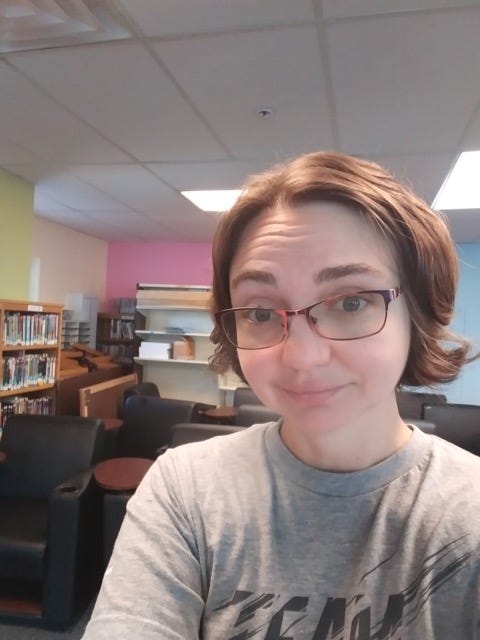
My first day as a librarian in a post-asbestos removal K-8 library, 2017
Does this seem unlikely to you? I later learned there has been a trend to replace credentialed school librarians with paraprofessionals, or eliminate the position altogether, for more than a decade. That’s a topic for another day. The point is, before I became a librarian I looked at books only from the view of what I liked to read, what my kids liked to read, and what I wanted my kids to read. When I began to look at the library as a whole, it gave me a different perspective.
The View From the Circulation Desk
Libraries are created for different purposes. A school library supports the educational needs of the students at that school. I later worked at a public library where I learned that the collection prioritizes what is popular. School libraries, especially now when people and governments are highly interested in what they contain, involving juggling the needs of different groups of people. It’s a tough job because it’s essentially a Venn diagram where none of the circles meet.
What administrators and government officials want students to read
What teachers want students to read to learn what they’re supposed to
What students actually want to read
In addition, I noticed trends when I observed what the students chose. Almost all young adult books (YA) are written in first person, usually present tense. Short chapters, to match short attention spans, are popular across all age groups. Some of the things I noticed were uncomfortable. For example, no matter how many diverse books I showcased, the white students only checked out books by white authors with white characters on the cover. I asked myself how many books by white authors I had read. Then…I spent a lot of time reading novels written by diverse authors.
Enter the Pandemic
So there I was, happily minding the library when—okay, that’s not quite true. The school principal had embarked on a mission to pull any potentially offensive books from the library. This is also a trend that has only accelerated as more states have gotten involved in legislating library contents. I didn’t initially object to this plan. I mean, The Martian did have a lot of profanity to be in an elementary school library. But at some point things seemed to get out of hand and I found myself writing an email to the principal to ask why I wasn’t allowed to buy a picture book titled A Unicorn Named Sparkle.
By the time the pandemic popped up in my third year, there were 3000 fewer books in the library and I’d generally made a nuisance of myself by asking too many questions and objecting to various decisions that were made. The principal decided my position was no longer needed.
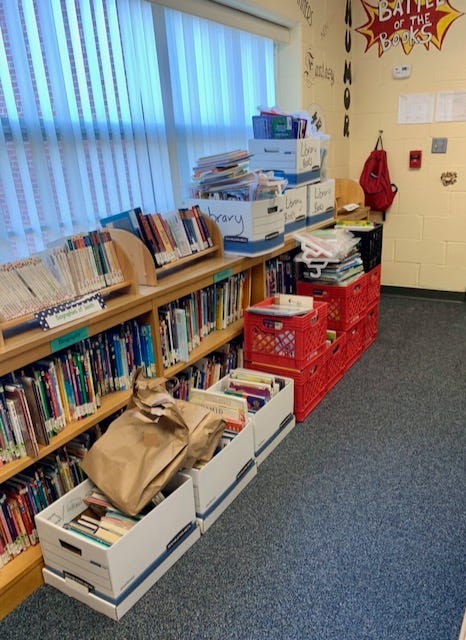
On my final day, I checked in boxes of books returned via scheduled drop off event
It was close to nine months before I was able to find a job. My new occupation was making bottles for infants in the NICU of a local hospital. I missed the library so much I could have cried. I actually did cry, a lot. I decided to start a Master’s program in Library Science. A year into the program I was able to leave the bottles behind for a part-time job at a public library while I continued to work on my degree.
And now I’m a writer
One of the professors in my program focused on censorship and book banning. She sent around a notice that she was soliciting essay submissions to be considered for her newest. I wrote an essay about my experience. It was cathartic to write out how I had gone from initially supporting the project to beginning to question some of the decisions and finally being appalled at the greater impact the removal of 3000 individual books had on our library as a whole. My essay was accepted. It can be read in The Fight against Book Bans: Perspectives from the Field, edited by Dr. Shannon Oltmann.
Even more exciting, I was contacted by the acquisitions editor of the publisher. She said she loved my essay and wondered if I had any interest in writing a full book. Publishing moves at a glacial pace so months went by before I had a book proposal that was approved by the publisher. I was matched with a co-author. I accepted a job as a high school librarian, all of my kids now being older and medically stable. I spent the next year working at a new school, finishing my MSLS, and writing the book.
I received that email from the acquisitions editor on September 20, 2022. On October 2nd, almost exactly three years later, The Quick-Start Library Guide will be published. I’m grateful for the opportunity and proud of the work Amy and I did to create this resource for paraprofessionals and new school librarians.
However, before I wrote The Quick-Start Library Guide, before I received the email from the acquisitions editor, I had begun writing fiction. I wrote a novel, queried it to agents, rewrote it, queried more agents, and now I’m writing a second novel still without a literary agent. I’ll write about that journey here and there, but there are plenty of Substacks where you can follow writers writing about writing.
Instead, I have half a dozen posts in my drafts folder about how becoming a librarian has changed how I look at books and how writing has changed how I read books. I would say reading, writing, and librarian(ing?) don’t intersect in quite a tidy right angle—hence “Beveling Books.”
Please subscribe if you’re interested (I have no plans to charge) and say hi in the comments.
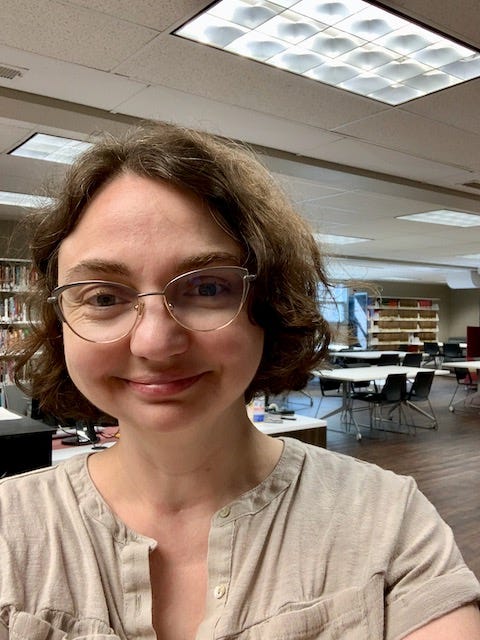
My first day at my new high school position.