
Dear Concerned Parent
A few (okay, a lot of) thoughts from a school librarian
April is School Library Month. People who are anti-book censorship are vocal about their position—but it’s not popular to say “I’m in favor of removing books from libraries.” I want you to know, I see you, quietly hitting the unsubscribe button if you see yet another post about “book banning.” I know you aren’t in favor of banning books—after all, parents can buy books from a bookstore if they want their children to read them. You are genuinely concerned about what your children are exposed to in their school library.
Let me tell you why the headlines and proposed laws aren’t about what you think they are.
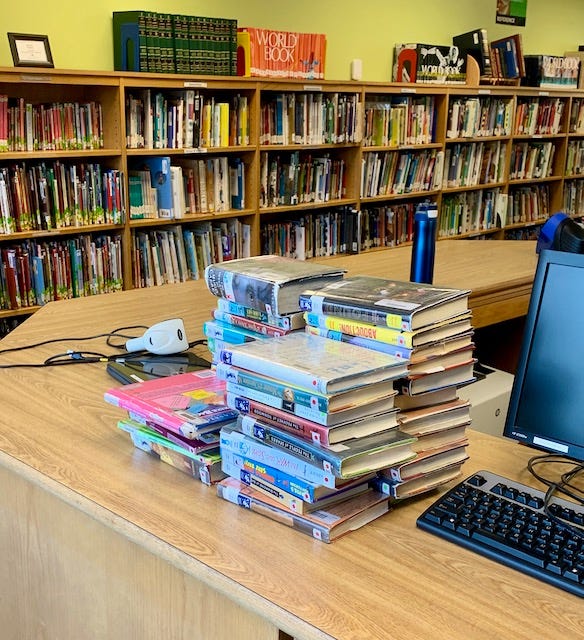
The PreK-8th grade school library where 3,000 books were removed over a three year time period.
Who Is Really Objecting to These Books?
You probably aren’t familiar with the term “library stakeholders.” The stakeholders of a library are those who have a stake, or a direct interest, in a library. For a school library, this would be the parents who have children enrolled in the school or the greater school community. In a public library, the stakeholders are members of the community served by that library.
Why is this important? Because more than 70% of attempts to remove books from libraries are made by people who have no stake in the library. Most haven’t even read the book in question. Instead, they’ve received a call to action email with an out of context snippet “proving” the book is objectionable. This means a person who has never step foot in your community, who has no children at your local school, can have an impact on the books your child has access to. Each library’s collection is unique, chosen by librarians who are familiar with your community and what makes it special. Don’t prioritize the opinions of outsiders over community members.
Librarians Are Professionals
Purchasing books for the library collection is the job of a librarian. When I order books, I have a wide range of tools to help me make an informed decision. I read book reviews, look for content warnings, and sometimes read an excerpt. I have a degree that taught me how to evaluate books. I am paid to choose and purchase books which meet the criteria for the library.
Administrators and politicians routinely exert control over purchasing decisions without any education or specialized knowledge. I once spent a lot of time evaluating biographical books about Ruth Bader Ginsburg to find one which did not mention contentious political decisions. An administrator removed the book saying it was “too negative toward men” because it accurately stated that Ruth faced obstacles to enter law school.
Another time, I was not allowed to purchase A Unicorn Named Sparkle. Why? I have no idea. But I can guarantee that the administrators and politicians who are crossing out books based on titles or some vague idea of inappropriate content has not put even a fraction of the time into making that decision as the librarian who wanted to place the order.
Librarians Move or Remove Books
Sometimes, despite our best efforts, a book we purchased is not appropriate for an age group or for the school. We know this happens and are happy to remedy the situation. Although it doesn’t make the headlines, we routinely remove or reclassify books to insure children have access to material that is appropriate for them. It’s part of our job.
There is no conspiracy of librarians trying to sneak inappropriate material to children. Just trust me on this one.
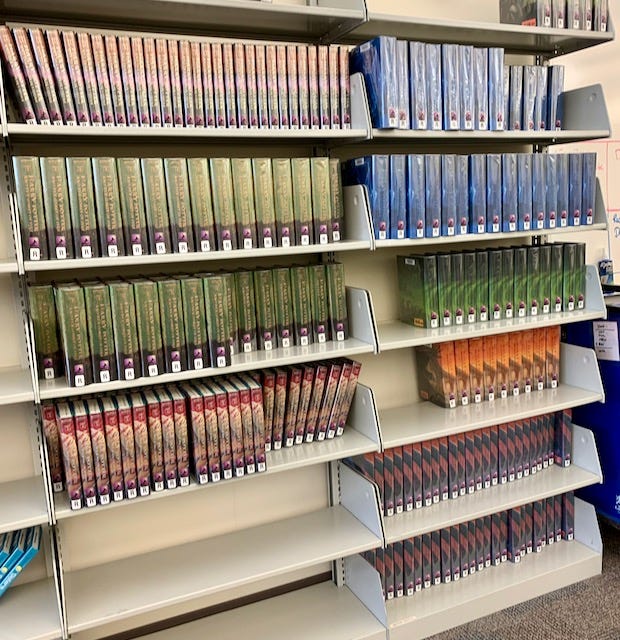
A public library’s stash of Harry Potter replacement copies collecting dust in storage.
Censorship Goes Both Ways
Let’s go back to A Unicorn Named Sparkle. If I told you it was vetoed because someone thought it was LGBTQ coded would you be more inclined to agree it was inappropriate? Would your opinion change if it was vetoed because it contained damaging stereotypes to young girls?
A well-known example of a beloved series which is now condemned by very different groups of people is Harry Potter. Once considered pro-witchcraft and dangerously satanic by fundamentalist Christians, after JK Rowling’s transphobic remarks an entirely new group of people would like the series off of shelves.
If you are in favor of books being removed because they don’t fit your values, you should be prepared for books you support to also be removed. People in favor of removing books say it will only apply to books that are “harmful to minors.” This is a phrase that can be applied to anything.
In the purge of the library where I worked, the review (not conducted by me) was pitched as removing a few books clearly inappropriate for elementary or middle schoolers. No objective standards were set. Leviathan by Scott Westerfield was almost removed because the female protagonist pretends to be a boy in order to work at a job reserved for males. The book reviewer fretted this might be a way to introduce transgender to unsuspecting children. (It wasn’t.) I pointed out that this plot device is so old, Shakespeare used it in As You Like It and Twelfth Night, among others.
The more administration looked for inappropriate content, the more they found. At the time I was informed my position was being eliminated, over 3,000 titles had been removed from a library of approximately 7,000 books. Does anyone really think almost half the books purchased by qualified librarians were inappropriate?
Librarians Respect Parental Rights
As a parent, what my children read was important to me. When we went to the library, I asked my kids to bring their books to me before they checked out so I could look them over. I reviewed books before I read them aloud. I decided not to read Skippyjon Jones to my kids because I thought (and still think) it’s full of stereotypes about Mexicans. Skippyjon Jones on the list of banned books for this reason. However, not bringing it into our home was my decision as a parent. As the school librarian, I did not remove the series from the school library because it is up to parents to decide what is appropriate for their children.
Removing books that you personally deem harmful from a library does not respect the rights of other parents to make decisions for their children. Libraries, both public and school, serve an entire community not a specific family.
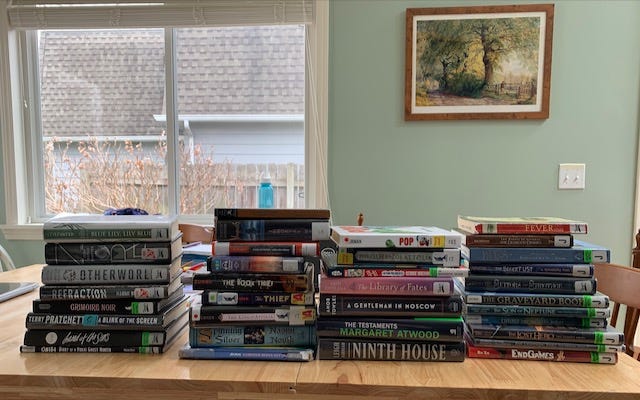
An eclectic selection of books grabbed by my teens the day before the libraries closed for the pandemic.
Removing Books Doesn’t Change Reality
In my essay “A Library Without Controversy” I wrote about how the removal of thousands of books from a single library transformed it. The books in that library presented children with a world where there was no divorce, no drugs, no siblings who died by suicide, and no racism. A world where everyone was straight and nearly everyone was white. The problem with that uncontroversial library was that it didn’t match the lives of the students. Let me give you a few examples.
Books by contemporary Black authors were removed from the library because they contained too many “mature themes.” Elementary and middle school students shouldn’t know racism still exists. They can only learn about it as something that existed in the past, with historical fiction like The Slave Dancer by Paula Fox. (Related side note: older books are always presumed to be unobjectionable without any evaluation of their actual content). We did have Black students at this school. Essentially, books that depict Black life experiences were removed to protect the feelings of white students.
Amanda Jones, the school library who is well-known for fighting book banning in her community, has said her motivation was not wanting to lose any more gay students in her district to suicide. Gay people exist whether they appear in library books or not.
Laurie Halse Anderson is the author of the frequently banned book Speak, which is based on her personal experience of being r@ped the summer before she started high school. In her memoir Shout, she shared a story of visiting a school where multiple students told her they really connected with Speak because the same thing had happened to them. The principal canceled the assembly at the last minute because things like that didn’t happen to the students at their school and they shouldn’t hear about it.
Perhaps your child hasn’t encountered any of these things and you want to preserve their innocence. That is your decision to make as their parent. However, there are other students at your child’s school who have experienced these things and they would like to books to help them understand it, to know they aren’t alone.
Books are Important to You
Concerned parent, I know you want library books to be available to your child. The reason why you’re concerned with the contents of the library is because you want to set your child free among the shelves, letting them choose from an enormous number of wholesome, whimsical books.
Administrators have been cutting budgets and staffing for school libraries for two decades. The pandemic only made this trend worse. Across America, 30% of school libraries have no librarian. About 10% of schools have no library at all. It takes no great imagination to see how tempting it would be to stop the headache of parent complaints about books by shuttering the school library altogether. During this school library month, take a moment to consider the many benefits a school library brings to education and realize what a privilege it is for a school to have one. And speak up the next time someone suggests removing books from your library.
Do schools in your district have libraries and a school librarian? In my state, 43% of schools have no librarian.

Are You A Classics Collector?

It’s senior brit lit paper all the time this week at my high school. This is a Very Big Project and the deadline is looming. When I have my lunch break and peruse Substack, I see so many people writing about their ambition to read more classics in 2026 or joining a group read of a classic. The universe is sending me a message to share what I’ve learned …
Christmas: Not just for white people and cute animals

(Note: This post focuses on Christian and secular Christmas books. I don’t want to tack on Hanukkah simply because it occurs around the same time as Christmas. Please do surround your children with books about the holidays of other religions and cultures.)
As always bars. Learning more about how the state wide banned books list worked in my home state Utah really radicalized me on this issues. People who have no stake in the library should not able to object to the libraries contents.
It's so helpful to learn about how banning books impacts students, and their school and greater community from the perspective of a professional librarian!