
Passing by Nella Larsen
A reimagining of the "Prodigal Son" parable?
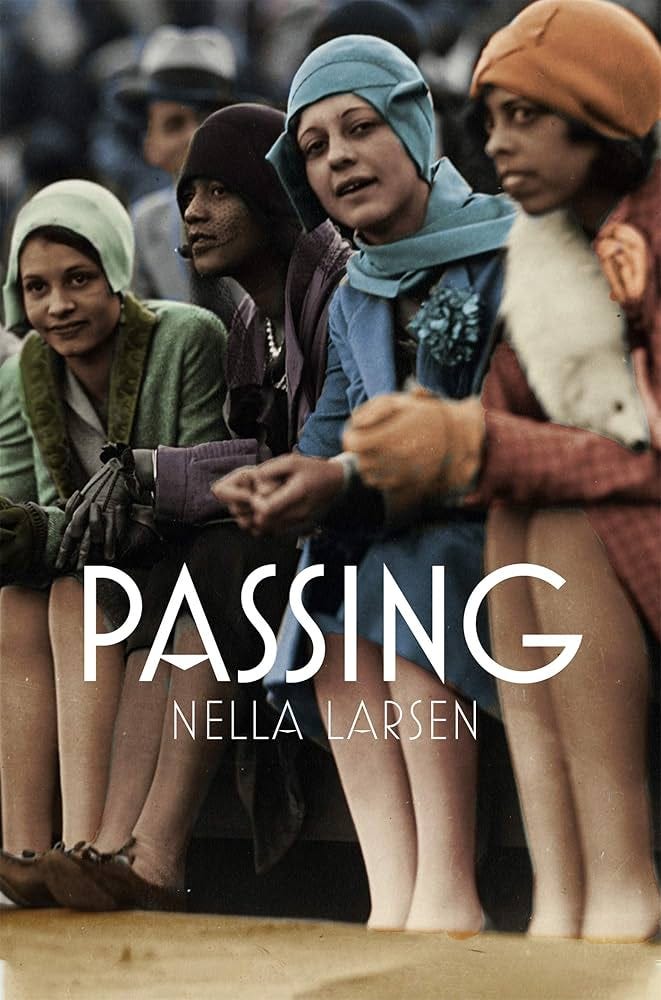
Colorized photo from the MacMillan edition of Passing.
Nella Larsen is a Harlem Renaissance author whose work is having a revival along with Ann Petry, who wrote about twenty years after Larsen. Passing is Larsen’s best known work. It is often interpreted through the LGBTQ lens. When I read it, I didn’t get that impression. But don’t think I’m arguing against it—one thing I love about literature is how books can be meaningful in completely different ways to the people who read them. What stood out to me was how similar Passing was to the parable of the Prodigal Son.
The protagonist of the story is Irene, a Black woman who is light enough to pass for white. Although we first meet her taking advantage of this fact by having tea at a whites-only hotel restaurant, she has married a Black man and moves in the circle of the wealthy Black social elite. While at the restaurant, Irene runs into Clare, a childhood neighbor who is also light enough to pass for white. In Clare’s case, she has married a racist wealthy white man, keeping her identity a secret from him.
When Clare spots Irene at the restaurant, she’s eager to catch up. Beautiful and charismatic, she pushes Irene to accept an invitation to visit her home. Irene reluctantly accepts. When Clare’s husband returns home during the visit and Irene realizes how much Clare could lose if her deception is discovered, she’s angry at how lightly Clare has taken such a risk. Irene leaves, commenting to a friend that Clare has “got what she wanted and …said it was worth it.”
Although Irene had hoped to have nothing more to do with Clare, a few months later she appears again. Clare has come to realize how much she has given up in turning her back on her race. She is eager to spend more time in Black society. Her husband often travels for work and Clare takes advantage of that. Irene sees Clare as selfish. She comes across as jealous of Clare’s beauty and charisma.

Passing Netflix adaption (2021)
Passing touches on many different issues. Larsen questions why white Christians treat Black people so poorly. We see the contradiction of white people flocking to events in Harlem to enjoy the culture of the race they find so inferior. Irene’s husband quips that “Pretty soon the coloured people won’t be allowed in at all.”
Irene is not without her flaws. Although she claims to appreciate her race, she is colorist, while Clare is happy to dance with men with dark complexions. Irene and her husband disagree about how to raise their sons. She wants to shield them from racism as much as possible while he thinks they need to be exposed to the real world. She comes across as naive in thinking their wealth can protect her sons from racism.
It was Irene’s view of Clare that I found fascinating. Irene feels entitled to her husband, her children, and her place in society because she has followed “the rules” by staying with her race. In her view, if Clare chose to reject her race, she shouldn’t be able to come back.
In the Prodigal Son parable, the prodigal son demands his inheritance early. It has the implication that he wished his father was dead. But when he’s lost his money and is left with the consequences of his action, he begins to value his family as he didn’t before. When he returns, his father greets him, giving him a ring, a fine robe, and prepares to throw a party for him. The brother who has been faithful to his father the entire time objects to this. After all—everything the father is giving to his no-good brother belongs to him!
Like the older brother, Irene resents Clare trying to have her cake and eat it, too. Soon Clare isn’t content to simply show up at parties. She’s doting on Irene’s sons and becoming close to her husband. While we don’t know whether the older brother got his resentment under control in the parable, the situation in Passing comes to a shocking ending.
If you’ve read Passing, I’d love to hear what you thought.


Are You A Classics Collector?

It’s senior brit lit paper all the time this week at my high school. This is a Very Big Project and the deadline is looming. When I have my lunch break and peruse Substack, I see so many people writing about their ambition to read more classics in 2026 or joining a group read of a classic. The universe is sending me a message to share what I’ve learned …
I loved the book. I also liked the movie based on it.
I've never heard of this book, but now I'm intrigued! It's so thought-provoking!